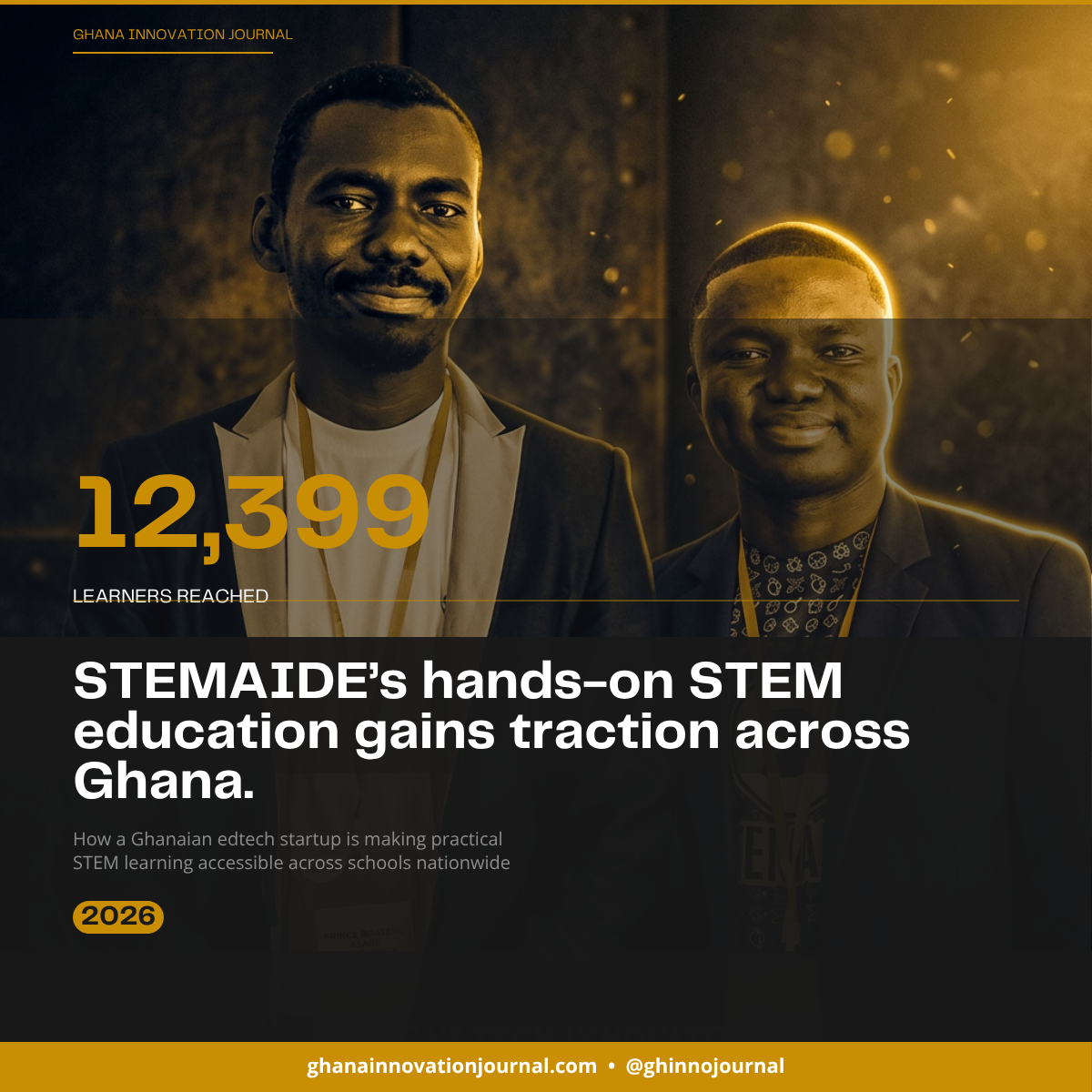
STEMAIDE says its STEM education programmes reached 12,399 learners in 2025, according to figures released in its latest impact report.
The Accra-based startup develops hands-on STEM learning kits and training programmes designed to help students learn science and technology concepts through practical projects rather than classroom theory. The kits contain components such as microcontrollers, sensors, wires, and other electronics that allow learners to build and test more than 200 projects covering robotics, coding, and basic engineering principles.
Founded in 2022 by Prince Boateng Asare and Joshua Opoku Agyemang, STEMAIDE provides tools and training aimed at strengthening problem-solving, creativity, and technical skills among young learners.
Expanding access to practical STEM learning
According to the report, the company’s programmes operated in 11 of Ghana’s 16 regions during the year. Participation included 6,511 male learners and 5,847 female learners, indicating near gender parity across its programmes.
The initiative also included 56 learners from rural communities and eight learners with disabilities, reflecting an effort to expand access to technical education beyond urban centres.
STEMAIDE reported that 701 learners achieved defined programme outcomes during the year, including 420 male learners and 281 female learners. The company also recorded 96 rural learners among those who reached the outcomes.
Training teachers to scale STEM education
Beyond student programmes, the startup is also working with teachers and schools. The report states that 302 educators received STEM training through its programmes, including 206 male teachers and 96 female teachers.
Teacher training is part of the company’s strategy to expand adoption of hands-on STEM instruction within existing school systems.
During the year, STEMAIDE also recorded 38 new institutional partners and worked with 56 schools across the country.
Addressing a skills gap in technology education
Interest in STEM education has grown across Africa as governments and private organisations seek to build a workforce capable of supporting digital industries, engineering, and scientific research.
However, many schools still rely on theory-based teaching methods and lack access to equipment that allows students to experiment with technology and engineering concepts.
STEMAIDE’s approach focuses on project-based learning, where students build working prototypes and explore concepts such as electronics, robotics, and programming through guided projects.
The company says this approach is intended to help students develop practical technical skills earlier in their education.
Startup recognition and expansion plans
STEMAIDE has also gained visibility within Ghana’s startup ecosystem. The company has been recognised as EdTech Startup of the Year at the Ghana Startup Awards for three consecutive years, reflecting growing interest in practical STEM education solutions in the country.
The startup was also selected for the 2025 Mastercard Foundation EdTech Fellowship, a programme implemented with MEST Africa that supports African education technology startups.
STEMAIDE says it plans to expand its reach through additional school partnerships and broader distribution of its STEM kits, with a long-term goal of increasing access to technology education across Africa.