For years, the pitch to Ghanaian pension funds has been simple: stop parking all your cash in government bonds and start investing in the local factories that actually drive the economy. This week, one of the country’s biggest players doubled down on its mission to invest in the real economy.
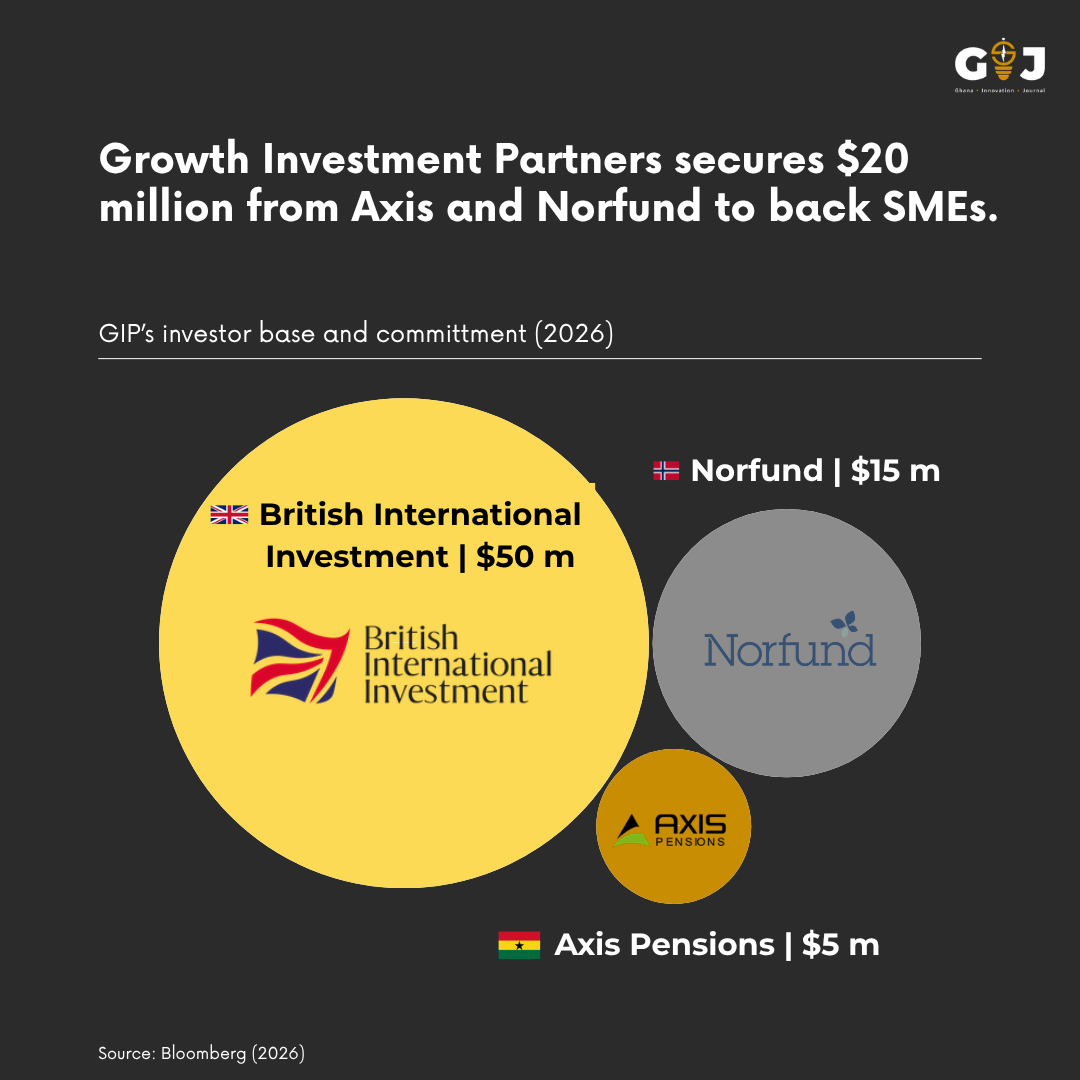
Growth Investment Partners (GIP), the permanent capital vehicle launched by British International Investment in 2023, has secured $20 million in fresh equity from Axis Pension Trust and the Norwegian development finance instituion, Norfund. Axis committed $5 million whiles Norfund committed $15 million.
GIP is moving from a 100% UK-backed pilot into a hybrid vehicle powered by other investors including pension retirement savings. It is a direct test of whether local institutional capital can be lured into the “missing middle”—the $500k to $5m funding gap that’s too large for microfinance and too “un-sexy” for global private capital.
The Cedi-First Thesis
One of the biggest killer of Ghanaian SMEs isn’t a lack of talent; it’s the FX trap. In a market where the cedi is notoriously volatile, borrowing in dollars or euros is a death sentence for a local manufacturer.
GIP’s model is an arbitrage play on this risk. They deploy exclusively in Ghanaian Cedis (GHS) and use a “permanent capital” structure. Unlike a standard PE fund with a five-year exit clock, GIP is a limited liability company that can hold assets indefinitely.
This allows them to offer what they call “partnership capital”:
- Revenue-linked repayments: Giving businesses room to breathe when cash flow is tight.
- Longer tenors: Offering 5-10 year horizons that allow a factory to actually be built before the bill comes due.
The New LP Mix
The entry of Axis Pension Trust which manages over GHS 10bn marks a shift for local trustees who have historically been “bond junkies.” By investing in GIP, Axis is essentially outsourcing the due diligence. GIP acts as the professional layer that de-risks the real sector for institutional investors who don’t have the boots on the ground to monitor a garment factory in Koforidua.
Norfund, the Norwegian DFI, provides the international anchor, bringing GIP’s total capital base to roughly $70m.
The Portfolio at a Glance
GIP isn’t hunting for unicorns; it’s hunting for EBITDA. Its 16-company portfolio is a pivot away from the high-burn fintechs that dominate Lagos or Nairobi:
| Company | Sector | Mission |
| Maagrace Garments | Manufacturing | Scaling local apparel for export. |
| Truecoco | Agro-processing and durable carbon removal | Organic coconut and cocoa value-add. |
| eServices Africa | BPO | Positioning Accra as a global back-office hub. |
GIP is a massive experiment in currency-risk management. If GIP can show that a portfolio of Ghanaian manufacturers can provide consistent returns in cedis, Axis won’t be the last local fund to sign a cheque.
But the hurdle remains high. To “crowd in” more pension money, GIP has to prove that investing in a local cocoa processor is more than just a patriotic gesture. it has to beat the (admittedly volatile) returns of government paper. For the 150 SMEs GIP plans to fund over the next decade, that’s a lot of pressure on the balance sheet.