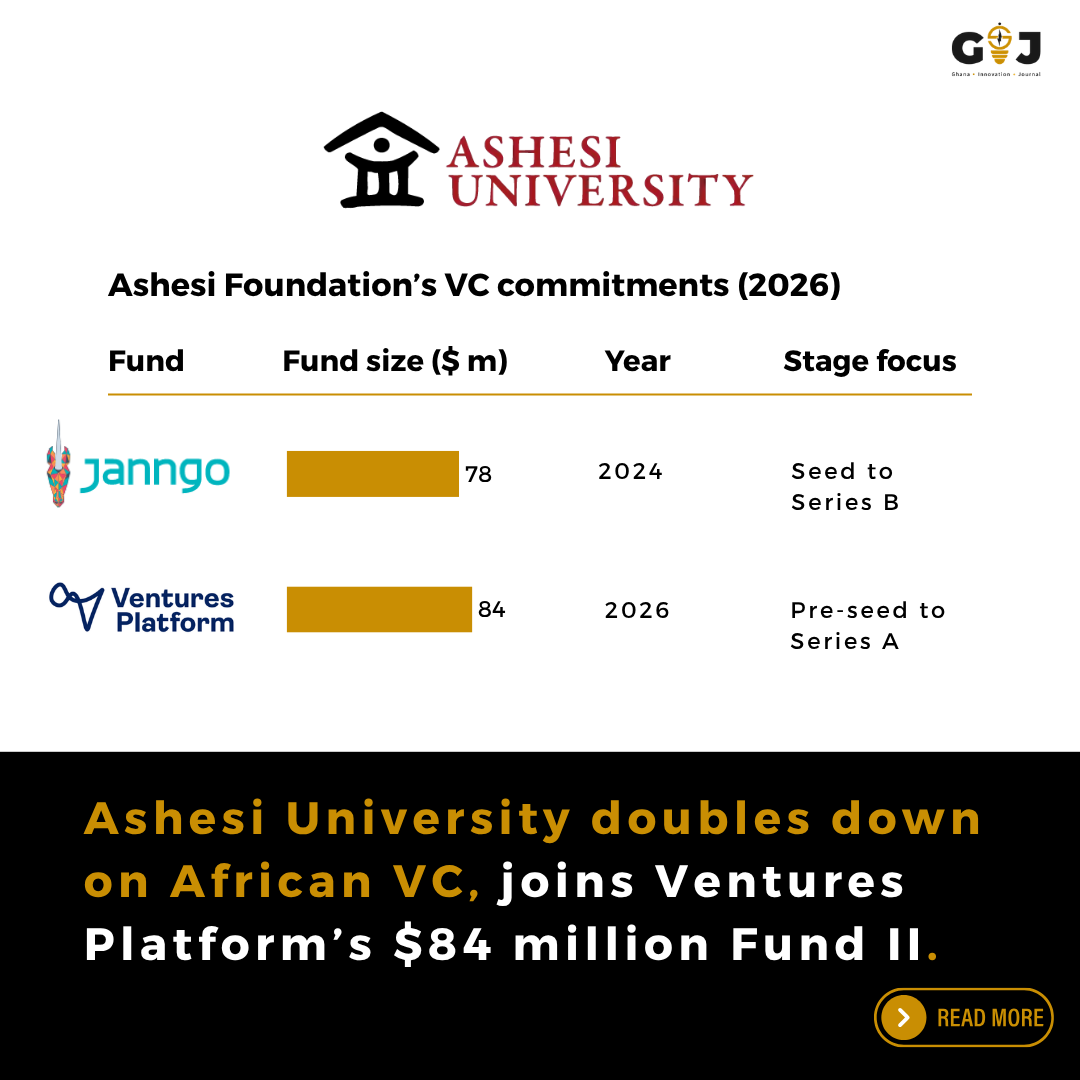
Ashesi University Foundation is deepening its commitment to African venture capital, joining Ventures Platform’s second pan-African fund as a limited partner.
The commitment marks Ashesi Foundation’s second investment in an African venture capital fund, following its investment in Janngo Capital. The move positions the Ghanaian institution as an increasingly active participant in Africa’s private capital ecosystem.
Ventures Platform closed its second fund at $84 million, exceeding its original $75 million target. The fund is almost twice the size of its $46 million predecessor, which closed in 2022.
For Ashesi, the investment represents more than another allocation to an alternative asset class. The Foundation is building a portfolio of African venture capital exposure while remaining closely aligned with the university’s focus on entrepreneurship and African economic development.
Ashesi is building a track record in African VC
Ashesi’s entry into venture capital began with Janngo Capital. In 2024, Ashesi University’s Endowment Fund invested in Janngo Capital, becoming the first academic institution in Ghana to invest from its endowment into a venture capital fund.
Janngo Capital focuses on technology companies across Africa, with investments spanning financial services, healthcare, logistics, retail, agritech, mobility and the creator economy.
The Ventures Platform commitment shows Ashesi is continuing along this path. Rather than treating venture capital as a one-off allocation, the Foundation is now backing a second fund manager with a broader pan-African mandate. A single fund commitment establishes exposure to venture capital. A second commitment starts to establish an investment strategy.
Ventures Platform is expanding beyond Nigeria
Ventures Platform’s Fund II gives Ashesi exposure to a fund with a substantially broader geographic mandate.
The firm was founded in Nigeria and its first institutional fund focused primarily on pre-seed and seed investments. Fund II expands the strategy across Africa, with investments already made in companies in Kenya, South Africa and Egypt.
The fund will invest from pre-seed through Series A and write initial cheques of up to $3 million, while reserving capital for follow-on investments. Its focus includes fintech, healthcare, SaaS and businesses where technology addresses fundamental gaps in African markets. AI is also a major part of the investment thesis.
The larger fund also comes at a more demanding point for African venture capital. Ventures Platform raised Fund II in a market where limited partners are asking harder questions about fund performance, portfolio construction, liquidity and manager differentiation.
A Ghanaian institution backs the infrastructure behind African startups
Ashesi’s role in the startup ecosystem has historically centred on education and entrepreneurship. The university has built programmes to develop entrepreneurs and support students building businesses. Its endowment investment strategy now extends this participation into the capital markets.
As a limited partner, Ashesi is not investing directly in individual startups. It is providing capital to a professional fund manager, who then deploys capital into a portfolio of African companies. This gives the Foundation exposure to a wider pool of startups while allowing professional fund managers to make individual investment decisions.
The model also creates a stronger link between Ashesi’s educational mission and its investment portfolio. The university develops entrepreneurial talent. Its Foundation provides capital to a fund backing entrepreneurs across the continent.
A precedent for Ghanaian universities
Ashesi’s first VC investment was significant because Ghanaian university endowments have largely remained outside the venture capital market. Its second commitment raises a broader question about the role of university capital in Ghana’s startup ecosystem.
Ghana has a growing pool of startups, fund managers and private capital investors. Yet local institutional capital remains relatively limited compared with the scale of capital required to finance companies through multiple stages of growth.
University endowments represent one potential source of long-term capital. Ashesi is now providing an example of how such capital could participate. The Foundation has moved from being the first Ghanaian academic institution to invest in a venture capital fund to becoming a repeat LP in African venture capital.
If other African universities follow the same path, university endowments could become a more meaningful source of capital for the fund managers financing Africa’s next generation of companies.
Leave a Reply