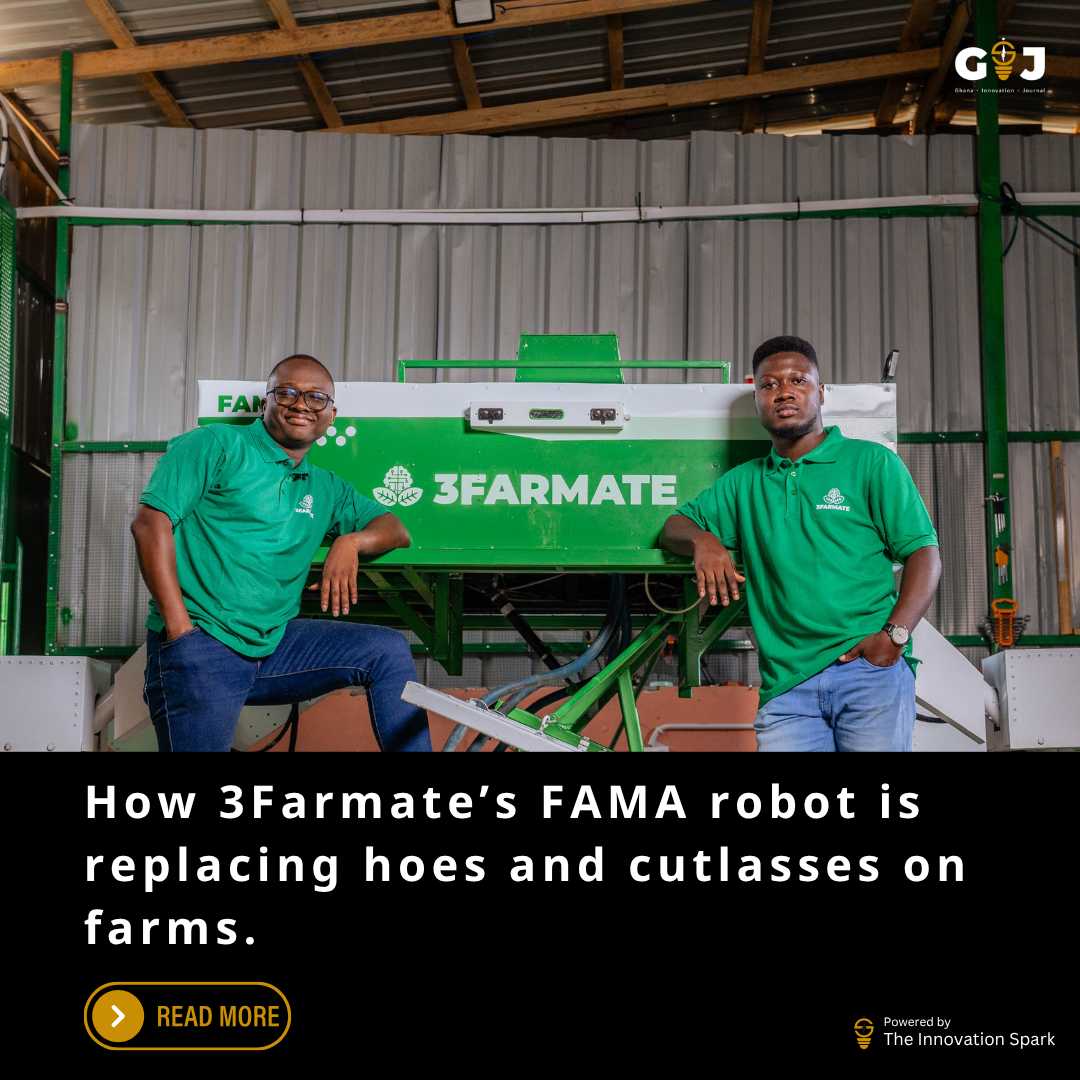
.Ghana’s agriculture sector still runs largely on hoes, cutlasses, and unreliable manual labour. In a country with millions of hectares of arable land, that gap between potential and actual productivity is what 3Farmate’s co-founder and CEO, Clinton Anani, is trying to close with FAMA—a fully autonomous, locally built farm robot designed to handle planting, fertilising, spraying, and weeding without a human driver.
From “hoes and cutlasses” to autonomous robots
Growing up, Anani was not exposed to farming. That distance is partly why the reality of how food is produced hit him later.
“As I grew up, I started to realize that we still cultivate with hoes and cutlasses, and it just did not make sense,” he said. “Back in university, I came down with the conviction that there had to be a better way.”
Tractors seemed like the obvious fix—but only on paper. In practice, they were expensive, required trained operators, and were still tied to inconsistent human labour.
“The thing with tractors is that you still require the human touch to get it to work,” Anani explained. “Even working with manual labor, you’re unable to find people to show up on time, to show up when you need them… that reliability issue just made it obvious that we had to build a solution that was not built around human labor.”
That conviction led to FAMA: a field autonomous machine for agriculture built not as a traditional tractor, but as a robot whose “driver” is software, sensors, and machine learning rather than a person sitting behind a steering wheel.
Why vision-based autonomy instead of GPS
Most self-driving machines in agriculture globally rely heavily on GPS for navigation and guidance. 3Farmate made a deliberate decision to avoid that.
“For robots in the same class as ours in different regions, they extensively require GPS to self-drive,” Anani said. “GPS is great because it’s available in your phone… But in farming areas where signal integrity is not very reliable, it doesn’t make sense to build technology around GPS.”
Instead, FAMA mimics how a human operator reads the field.
“We are trying to mimic how a human operates a tractor,” he explained. “We get it to understand what a field is first. We got tons and tons of data, and then we train the model to be able to know what the farm is, to be able to know the different states of the farm—if it’s plowed, if it’s harrowed, if there’s still weeds on the farm.”
Once FAMA understands the field state, it can execute specific tasks—planting, fertilising, weeding—without depending on external signals. The key differentiator here is that the AI “reasons and understands what the farm looks like” rather than just following GPS waypoints.
Built for Ghana’s smallholder economics
More than 90 percent of Ghana’s farmers are smallholders. That shaped both the hardware and business decisions behind FAMA.
“When you start out wanting to build something like this in a place like Ghana, your best options are just to import solutions,” Anani said. “But when you do that you end up with something that is really expensive and doesn’t meet the pocket needs of farmers in Ghana.”
3Farmate’s response was to do as much as possible in-house.
“We had to build as much of our technology in-house and we had to source parts from local suppliers,” he said. “We had to make sure that we built something that was not expensive and that was mostly made in Ghana, so we could have the chance to control pricing.”
According to Anani, that strategy is paying off.
“We’re currently the cheapest in the market so far,” he stated. “We’re cheaper than manual labor. Most people don’t believe it when we say it, but we are cheaper than manual labor. We are cheaper than working with tractors or uniform machinery as well.”
Impact data from 3Farmate’s early deployments backs this up: the company reports that FAMA can cut planting costs per acre by up to 60 percent compared to the combined cost of hiring manual labour or paying for tractor services, while also reducing chemical usage through more precise application.
Robotics-as-a-service instead of selling machines
Cost is not just about unit price; it’s also about how the product reaches farmers. 3Farmate is deliberately avoiding an upfront-purchase model at launch.
“What we are launching over the next couple of weeks is going to be a service-based model,” Anani said. “If you have five to ten acres and you want to cultivate corn, you’ll give us a call, we show up with the robot, we plant for you, and then we take the robot back.”
Under this model, 3Farmate owns and maintains FAMA. Farmers pay for the operation as a service, not for the hardware itself.
“We handle maintenance, we handle operations… and that is a very key moment for us to be able to experiment with this model,” he added. “It gives us the ability to give farmers firsthand what the service would look like, just so we demystify this whole talk about having to work with robots.”
This approach lowers the barrier to entry, lets 3Farmate learn from real usage, and turns FAMA into something farmers can test on a season-by-season basis rather than committing to a large capital purchase.
Data-heavy farming, monitored from Accra
FAMA is not just a machine doing physical work; it is also a data collection platform.
“The vehicle is a data-gathering beast, if I may,” Anani said. “We have tons and tons of sensors around the vehicle, gathering data around different aspects from image data to soil data to atmospheric data.”
That data serves two purposes. First, it improves how FAMA operates on the field over time. Second, it helps identify better practices for yield improvement and farm management.
“We’re also able to stream that data online to make remote access possible,” he noted. The longer-term vision is that “you can own the robot yourself and you can operate it from anywhere else in the world… you’ll be able to monitor it remotely as it’s functioning.”
Even at the current service stage, the implication is clear: a farm manager in Accra could see, in real time, what FAMA is doing on a field in Bono, including progress and field conditions, without being physically present.
Labour crisis and new roles on the farm
The question of jobs comes up in every conversation on automation, and Anani does not sidestep it. He argues that Ghana’s agricultural sector already faces a labour crisis.
“There is an exodus of especially us young people from rural areas where farming happens to urban areas,” he said. “Someone who worked in some community somewhere in the Eastern region growing corn would easily say that if I move to Accra and I ride a motorcycle I will make a lot more money than working on a farm.”
If that trend continues, he warned, “it means that there’s only going to be old people, who should not even be working on the fields, will have to grow the food for us.”
For 3Farmate, FAMA is a response to that labour gap, not just a replacement for existing workers.
“Technology developments like ours, they’re bringing new jobs, high-skill, high-paying jobs,” Anani argued. “Because to operate the robot, you obviously need to be trained. These are all avenues that we can double on to make sure that the technology truly is beneficial to everyone across the industry.”
He also sees FAMA as infrastructure that other agribusinesses can build on. “We are building a core foundation that would make farming scalable,” he said. “Someone who previously had to go work the fields can now be a farm manager on his own because now he doesn’t have to worry so much about labor.”
Roadmap: pilots, distribution, and trust
With FAMA launched, 3Farmate’s focus over the next 12–24 months is to get robots working on as many farms as possible, and turn pilots into trust.
“Our biggest priority right now would be to make the service available,” Anani said. “We are going from ‘is there demand for robots like this?’ to ‘how much more can we make available based on demand.’”
The company plans to double down on manufacturing, distribution partnerships, and pilot programmes with farmers and crop production companies.
“The biggest issue right now in the industry is trust,” he admitted. “When you build new technology like we have, you have to make sure that you win the trust of the farmers. Otherwise, it’s just going to be another expensive piece of technology sitting somewhere else.”
Pilot deployments are designed to counter that: “We give them pilots, let them understand that this is not some technology that is like sitting in the clouds. It’s here. This is how you can access it. This is how it will work on your farm. And you’ll have the results to verify for yourself.”