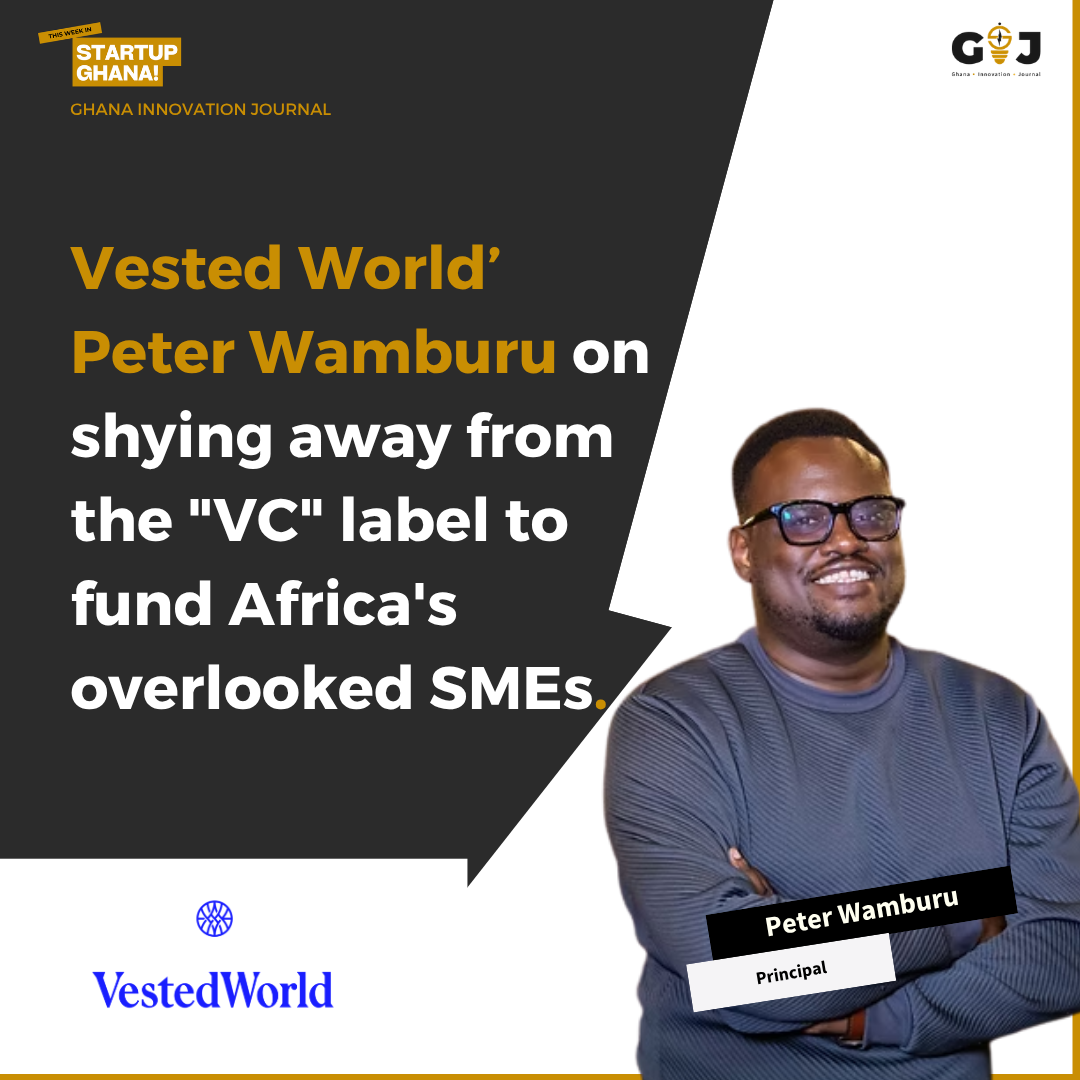
In this edition of the Innovator Spotlight Series, we sit down with Peter Wamburu, Prinicipal at Vested World. Vested World is an early-stage investment firm redefining startup funding by prioritizing societal impact, commercial viability, and gender equity.
In this interview, Wamburu shares insights on operating in the “missing middle” of investment, dismantling biases in due diligence, tracking the operational metrics that truly matter, and navigating the unique landscape of African entrepreneurship.
Redefining the sweet spot between VC and Private Equity
Ammishadai Ofori (AO): Vested World doesn’t quite fit the traditional venture capital mould, nor is it strictly private equity. How do you personally define that sweet spot? Why is investing in bankable companies that don’t fit traditional VC models the most sensible approach for generating both competitive returns and real impact in African markets?
Peter Wamburu (PW): We describe Vested World as an early-stage fund manager focused on essential products and services for African consumers. We anchor our investment thesis across three core thematic areas that are fundamental to economic development on the continent:
- Agribusiness: We invest across the entire agricultural value chain. For an economy to have a productive labor force, food security is a non-negotiable foundation.
- Consumer Products & Services: This covers highly diversified sectors including logistics, manufacturing, retail, distribution, and their supporting ecosystems.
- Enabling Technologies: We target technology deployed in practical, meaningful ways to enhance operational efficiency in traditional, brick-and-mortar sectors.
Our thesis sits between VC and PE because we do not take majority stakes, yet we look beyond purely software-driven plays. Around 70% of African economies are driven by micro-SMEs and SMEs. These businesses are often overlooked by traditional VC because they are perceived as lacking tech-driven scalability, and too small for private equity. By backing these foundational businesses, we help them transition to the next stage of growth. This is why we lean away from the “venture capital” label and prefer to call ourselves an early-stage investor focused on essential sectors.
The “M-Pesa mindset” and leapfrogging development
AO: You have previously spoken about the “M-Pesa mindset” i.e using technology-driven development to bypass capital-intensive, traditional development stages. When looking at agribusiness, logistics, and enabling tech, what specific business models or founding traits signal that a company has true “leapfrogging” potential ?
PW: Leapfrogging occurs because the continent has lagged behind in basic infrastructure, creating an opportunity to deploy modern capital and skip the experimental phases other global economies had to endure.
Take agriculture: mechanization is still very limited across the continent, with much of the land still tilled manually. We can leapfrog traditional development by bypassing fossil-fuel-reliant machinery entirely and moving straight toward alternative, renewable-powered mechanization.
Another prime example is cross-border payments. Traditional banking infrastructure across African borders remains heavily fragmented. Sending money between Kenya and Ghana is still unnecessarily complex and expensive. Because of this friction, we are actively looking at the use cases of stablecoins for cross-border payments. This is a tangible application that reduces transaction friction and costs, letting us leapfrog traditional banking infrastructure in favor of a decentralized solution.
Financing the “missing middle”
AO: Has there been an instance where Vested World said “yes” to an innovation that traditional Western VCs or PE firms turned down? What made you take the leap, and how is that company performing today?
PW: Frequently. Non-tech-enabled or asset-light businesses often fall into a “missing middle.” They are too small for commercial banks because they lack the required collateral, too small for traditional private equity tickets, and overlooked by venture capital because they lack the exponential growth trajectory of a pure software business.
We recently invested in a commercial bakery premix manufacturer based in Kenya. It is a highly traditional business, but it possesses a growth trajectory reminiscent of a tech startup. They were overlooked because they didn’t have a massive collateral base or an underlying software play.
Our funding helped them streamline procurement for commercial bakeries, simplifying a highly fragmented supply chain. Since we began engaging with them three years ago, the business has nearly tripled in size. This proves that non-tech-enabled businesses offering essential services can deliver outstanding commercial returns if given the right structural support.
Mitigating bias and privilege in due diligence
AO: Due diligence processes can subconsciously favor globally connected or highly polished founders. How do you actively address privilege in the VC space to ensure local African founders are not undervalued?
PW: It starts with a conscious awareness that privilege exists in capital allocation. We deliberately approach every entrepreneur with a high degree of humility and empathy. As custodians of capital, our job is to identify great operators, not just great presenters. Often, the less polished founders who spend less time on personal branding are the ones with the sharpest operational acumen and deepest execution capability.
To systematically eliminate bias, we ensure our due diligence process is entirely inclusive:
Multiple Internal Touchpoints: Deals are evaluated by different members of our team to ensure no single perspective or subconscious bias dominates the narrative.
Third-Party Assessments: We frequently bring in independent, third-party technical experts to validate operational realities and ensure we aren’t overlooking blind spots or misjudging a founder’s capability.
Commercial viability as the driver of impact
AO: Do you find that you have to make structural exceptions during due diligence to deliberately support underrepresented or female entrepreneurs?
PW: Our fiduciary mandate to our Limited Partners (LPs) is clear: we back businesses that we believe can generate strong commercial returns. At Vested World, impact is a consequence of a strong commercial outcome.
Historically, the most impactful institutions on the continent—like M-Pesa or Equity Bank—scaled because they solved a massive commercial niche for underserved audiences. The outsized social impact (job creation, financial inclusion) followed financial success.
That said, we firmly believe that innovation springs from a diversity of thought, not consensus. We do not make exceptions on commercial discipline, but we do actively look for and insist on diversity within management teams. We have formally committed to the 2X Challenge to actively back gender-diverse leadership teams and female-led opportunities, ensuring that local talent is comprehensively utilized.
Moving from traction to operational mastery
AO: You’ve had a direct hand in upgrading internal reporting systems. How can early-stage African entrepreneurs improve their data tracking to shift investor conversations from basic traction to true operational mastery?
PW: The gold standard rule for early-stage companies is simple: measure what matters. Startups have limited bandwidth, so you must focus strictly on the core variables that drive your revenue and cost structures.
If you run a service-oriented business, master your sales funnel metrics—know exactly how many client visits it takes to convert to a single unit of revenue. At the early stages, the sophistication of the tool doesn’t matter. You don’t need complex business intelligence software on day one. You can start with a notebook, graduate to an Excel sheet, move to a centralized database, and eventually adopt a dedicated BI tool as you scale. What matters to investors is that the management team clearly understands the handful of operational levers that dictate their business performance.
The three critical quantitative metrics for African Startups
AO: If you had to narrow it down to three quantitative data metrics that make you interested in a startup, what would they be?
PW: Beyond assessing the alignment and values of the human capital, the three non-negotiable metrics are:
- Capital Efficiency: We look closely at how much revenue or enterprise value a company can generate for every single dollar of capital injected. In a market where liquidity can suddenly tighten, capital-efficient execution is vital.
- Unit Economics: Founders must deeply understand their cost structures and pricing elasticity. If the price of fuel or raw materials spikes, can you pass that cost to the customer, or can you pull an internal operational lever to absorb it without destroying your margins?
- Working Capital Cycle: This is often the ultimate deal-breaker in African markets. You must know exactly how long it takes to convert revenue into hard cash. How quickly do your customers pay you versus when your creditors demand payment? Managing this cash conversion cycle is what keeps a business alive during macroeconomic headwinds.
Overview of his professional journey
AO: Your background is quite unique. You are a mechanical engineer by training who transitioned into startup operations, strategy, and now investment management. What led you to the investment side, and why did you choose Vested World?
PW: My career started in hardware product development at an early Kenyan tech startup manufacturing educational tablets. That was my first lesson in how difficult it is to commercialize a fantastic product. I then moved to a family-owned solar business in the renewable energy space, where I saw firsthand how cash flow realities dictate product strategies.
Desiring to understand the intersection of technology and finance, I joined an early-stage micro-lender to build their credit-decisioning systems and data infrastructure. Over four years, my role evolved into strategy, analytics, and fundraising, helping the business raise $5 million. That operational, hands-on exposure to venture capital inspired me to pursue a Master’s degree in Finance and Technology at the University of Glasgow.
When I returned to Kenya, I knew that to be a better ecosystem enabler long-term, I needed to understand capital allocation from the investor’s side of the table. I joined Vested World in early 2022. What completely sold me on the firm was the sheer humanity, intelligence, and deliberate “Afrocentric” mindset of the leadership team.
The future of local asset management
AO: There is an ongoing debate about whether Africans are truly capitalizing on the investment opportunities within the continent, or if it is largely being driven by international capital. Do you believe the local ecosystem is ready to fund its own growth?
PW: Ecosystem building takes time. The next generation of African fund managers are working as investment professionals right now within Africa-focused funds.
Macroeconomic factors like currency volatility and shifting budgets from international development agencies are forcing a healthy realization: we need local capital to back local businesses. Relying permanently on external capital is unsustainable.
We are beginning to see regional shifts. Across key hubs like Ghana, Nigeria, Egypt, Morocco, South Africa, and Kenya, local asset managers are increasingly looking to diversify their portfolios away from just real estate and government bonds. As the asset class becomes derisked, we will see an inevitable increase in domestic institutional allocations toward venture capital and private equity.
Quick-fire round
To wrap things up, let’s do a quick lightning round. First thing that comes to your mind:
What is one book every African investor should read?
PW: Why Generalists Triumph in a Specialized World by David Epstein.
What is the most undervalued sector in Africa today?
PW: The creative economy. With projections showing that one in three people globally will be African by 2050, the market potential for local content consumption and cultural export is massively overlooked.
If you were not a venture investor, what would you be?
PW: An entrepreneur. Without a doubt.