Venture capital is often presented as a straightforward formula: raise funding, scale quickly, and build the next breakout company.
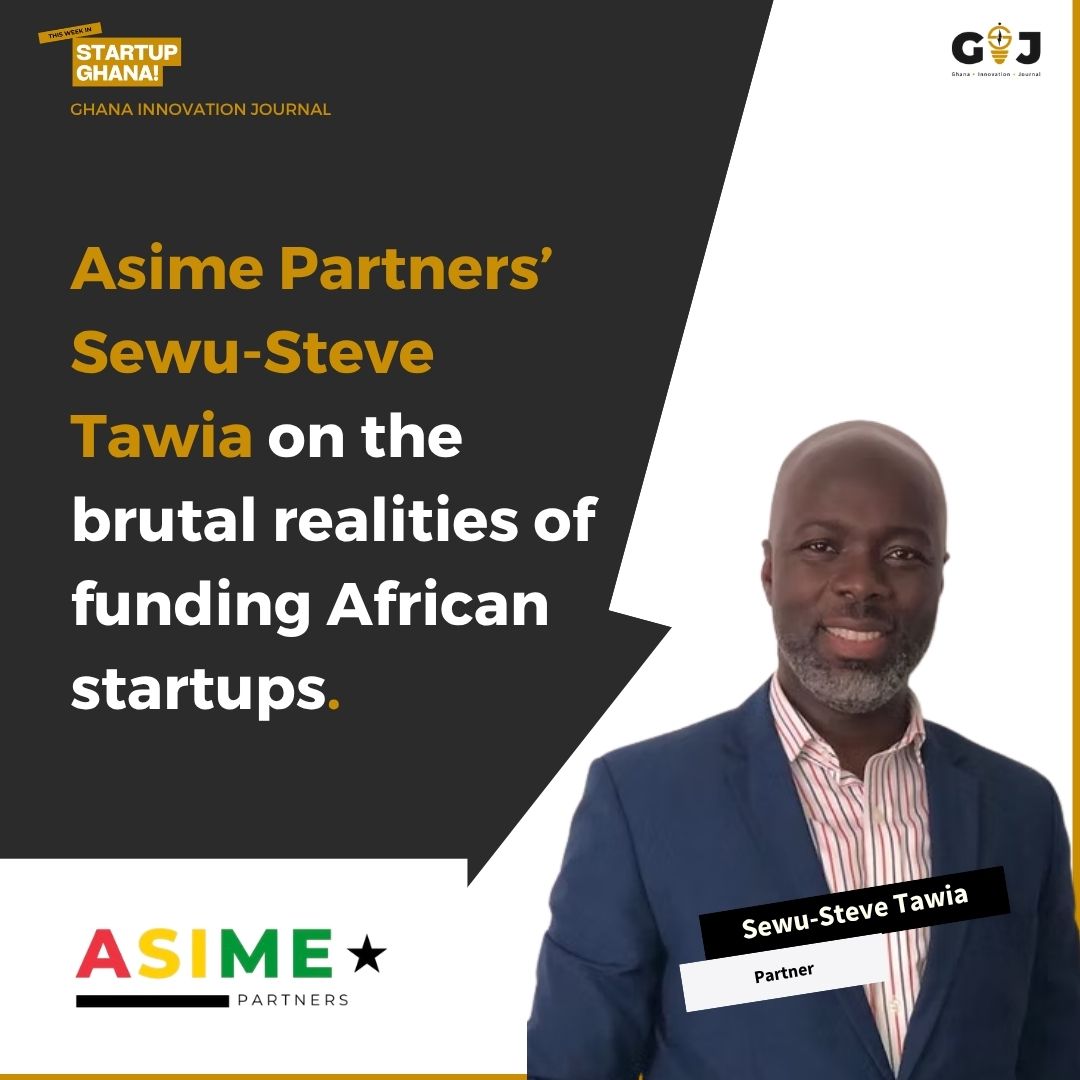
The reality, according to Sewu-Steve Tawia one of Ghana’s most active angel investor and Partner at Jaza Rift and Asime Partners, is considerably messier.
In a wide-ranging conversation on the Innovator Spotlight series, Tawia drew on more than two decades of experience across finance, consulting, development finance and startup investing to challenge some of the assumptions founders hold about capital, growth and risk.
From why most African businesses should not raise venture capital, to the dangers of taking money from the wrong investor, to his controversial view that “there is no such thing as an African VC ecosystem,” the discussion covered the hard truths that often get lost in conversations about startup success.
Along the way, he shared lessons from backing startups, explained why Silicon Valley is frequently misunderstood, discussed the founder traits he values most, and outlined how entrepreneurs can survive currency shocks and difficult fundraising environments.
This interview has been edited for length and clarity.
On the brutal reality of venture capital
Ammishaddai Ofori: You’ve personally invested in more than 30 startups. From your perspective, what does the survival-to-outlier ratio actually look like? What uncomfortable truths should first-time founders understand about the game they’re entering?
Sewu-Steve Tawia: It’s a bit of a two-way question.
From a founder’s perspective, what you need to realize is that you need to put all your resources and energy into your startup to make it what success looks like for you.
From an investor’s perspective, statistically, we know that if you build a portfolio of 100 companies, more than half — say 60% to 70% — will go bust or will not return the money you invested. That means only about 5% to 10% of companies will generate most of the returns. That’s the power law.
In developed markets like Western Europe, the United States and Canada, two, three, four or maybe five companies in a portfolio can return the entire fund and generate multiples on top of that — three times, five times, even ten times your money.
As investors, we have to look at every company as if it could be a fund-returner. But we’re human. We have biases. We can’t perfectly identify winners.
For founders, the key thing is different. You have to build a company that delivers the outcome you want.
If you don’t believe that, don’t start a company.
Why most African businesses should not raise venture capital
Ammishaddai Ofori: Those numbers don’t sound very optimistic. When founders are choosing between angels, private equity, venture capital or patient growth capital, how should they determine what type of funding is right for them?
Sewu-Steve Tawia: That’s a very important question.
Probably 80% to 90% of the companies we see — not just as VCs, but generally — truly need steady growth capital. That’s it.
The problem is that on the continent, the banks are not doing their job, and we don’t have enough patient capital or government-backed funding that can support businesses over the long term and help them become investable.
For technology companies, venture capital may make sense. But founders must understand what they’re signing up for.
And they need to do due diligence on investors.
I’ve seen angels approach companies and say, “I’ll invest $50,000 for 50% of your company.”
That’s a no-no.
People often focus only on getting money because they’re desperate for capital. But the colour of the money matters. The type of money matters.
Founders need to understand what kinds of investors exist, what instruments they use, what their investment thesis is, and what value they bring beyond money.
We also forget the 3Fs: Friends, Fools and Family.
The primary investor in your company is actually you. You’re investing your time, money, energy and resources.
The second investor is your customer. If somebody buys your product, they’re investing in your company.
Only after that do you start thinking about external investors.
And depending on your sector, grants may be more relevant than venture capital. In healthcare, for example, you have almost a 100-to-1 ratio between grant funding and investment capital. Some founders would be better off pursuing grants first and using them to reach a stage where they become attractive to investors.
Why founders must do due diligence on investors
Ammishaddai Ofori: Many founders feel they don’t have the luxury to be selective. Funding is scarce. Do they really have the ability to conduct due diligence on investors?
Sewu-Steve Tawia: They absolutely do.
Venture capital funding in Ghana is very limited. Most active investors are international funds. Local investment culture is generally conservative and risk-averse.
But regardless of how badly you need money, you still need to know what you’re getting yourself into.
I’ve seen founders take money from the wrong investor and end up watching their company fail because of the relationship that followed.
The due diligence on the investor is critical.
Again, if somebody says, “I’ll give you $50,000 for half your company,” that is not investment. That’s takeover.
You effectively become an employee.
The investor now has enough ownership to make operational decisions and dictate the future of the business.
That’s not how healthy startup investing should work.
The myth of Silicon Valley
Ammishaddai Ofori: If there is one venture capital myth that causes the most damage to African founders, what is it?
Sewu-Steve Tawia: The idealization of Silicon Valley.
People think venture capital started there. It didn’t.
For centuries, people funded high-risk ventures. Merchants financed ships and expeditions to Asia, funded crews and voyages, and expected returns multiple times their investment.
What Silicon Valley did was institutionalize that model.
And it wasn’t built purely by private investors.
Silicon Valley was built on DARPA.
For decades, the U.S. government invested billions of dollars into defence research, semiconductors and related industries. The ecosystem emerged on top of that foundation.
The same thing happened in places like Israel, South Korea and China. Government funding played a major role.
Yet in Africa, we’re trying to replicate the outcome without building the foundation.
It’s like trying to plant tomatoes in the desert.
You need to prepare the soil. You need water. You need the right techniques. You need an enabling environment.
If we’re serious about building innovation ecosystems, we need sustained investment over a decade or more. We need infrastructure. We need regulation. We need incentives.
“There is no such thing as an African VC ecosystem”
Ammishaddai Ofori: Looking back, what mistakes has the African VC ecosystem made over the last few years?
Sewu-Steve Tawia: So I’m going to be very controversial.
There is no such thing as an African VC ecosystem.
I always tell people: follow the money.
More than 70% of the venture capital invested in African startups is not African. It comes from North America, Europe and, to a lesser extent, Asia.
What does that tell you?
The money comes with its own assumptions, incentives and perspectives.
When people talk about African venture capital, I ask: if only 20% or 30% of the capital is African, can we really call it an African ecosystem?
For me, the answer is no.
It’s mostly driven by foreign investors.
That creates challenges because many investors don’t fully understand local realities.
We have seen founders raise enormous amounts of money from investors overseas, only for those businesses to collapse and create negative headlines for the entire continent.
But this isn’t unique to Africa. The United States had Theranos. Every ecosystem has bad actors.
The difference is that because our ecosystem is smaller, those failures become amplified.
One encouraging trend, however, is that more international investors are now requiring local investors to participate in rounds. They want someone on the ground who understands the market and can help de-risk the investment.
The founder trait that matters most
Ammishaddai Ofori: What is the most important founder trait you look for?
Sewu-Steve Tawia: Coachability.
Not obedience. Coachability.
You need founders who listen, process information and make informed decisions.
That doesn’t mean blindly following investor advice.
It means being open-minded enough to learn and adapt.
In our investment process, founders complete personality assessments as part of our due diligence. That’s how seriously we take this.
The second thing is grit.
People talk about resilience, but for me it’s broader than that.
Can you understand your environment?
Can you navigate regulation?
Can you anticipate risk?
Can you manage relationships with tax authorities?
Can you understand how policy changes affect your business?
I call it being street-smart.
When I see somebody who has spent their entire life in one market and suddenly wants to build a business in a completely different country without understanding how it works, that’s a concern.
The KPIs that actually matter
Ammishaddai Ofori: Beyond vanity metrics, what operational KPIs tell you a company is genuinely surviving?
Sewu-Steve Tawia: It depends on the sector, geography and stage.
But generally, revenue growth, unit economics, runway and profitability all matter.
One thing we pay close attention to is founder ownership.
By Series A, we like to see founders still owning more than 50% of the company — ideally around 60%.
Our view is that founders shouldn’t dilute more than about 10% to 15% per round.
If you raise three rounds before Series A, you should still be in control of your company.
You’re still in the driver’s seat.
You’re still able to make key decisions.
Beyond that, the specific KPIs vary. Healthcare is different from deep tech. Deep tech is different from agriculture.
The important thing is to have KPIs and track them consistently.
Surviving currency shocks
Ammishaddai Ofori: Speaking of KPIs, i n 2020, one of my good friends raised $3 million to distrupt LPG distribution and COVID hit. Suddenly, the price points that he had modelled his runway, projection etc. on had shot up. So in a case like this, where there’s serious currency volatility, how does a founder manage the situtation.
Sewu-Steve Tawia: Unfortunately, on this continent you’re going to face headwinds.
Currency devaluation is one of the toughest.
The Ghanaian cedi, Nigerian naira, Kenyan shilling, South African rand — these fluctuations affect founders and investors alike.
When that happens, you need to live within your means.
You need to cut costs as much as possible while maintaining your core operations.
The goal is to reach what I call default survival.
Once conditions improve, you can return to growth.
But first, you need to survive.
Fast-fire round
To conclude, we had a “fast‑fire” round of scenarios and ask him to respond with a simple “fund” or “pass,”.
Scenario A: A high-growth B2C AI-commerce app with incredible user numbers but very low average transaction value. Are you funding it or passing it?
Answer: Pass.
Scenario B: A fintech building a proprietary solution that requires deep regulatory change in two major markets to operate legally.
Answer: Pass.
Scenario C: A B2B SaaS platform that’s solving a critical supply chain problem for local industry
Answer: Funding, the main reason is B2B enterprise is usually stable.
Scenario D: A founder from a recently failed startup is pitching a new idea in the same sector.
Answer: Pass.
Taken together, those answers say as much about his approach as any formal thesis document. He prefers boring stability to flashy growth, and structural realism to myth. The power law may be unavoidable, but for founders, the real game is choosing which odds to play and with whom.