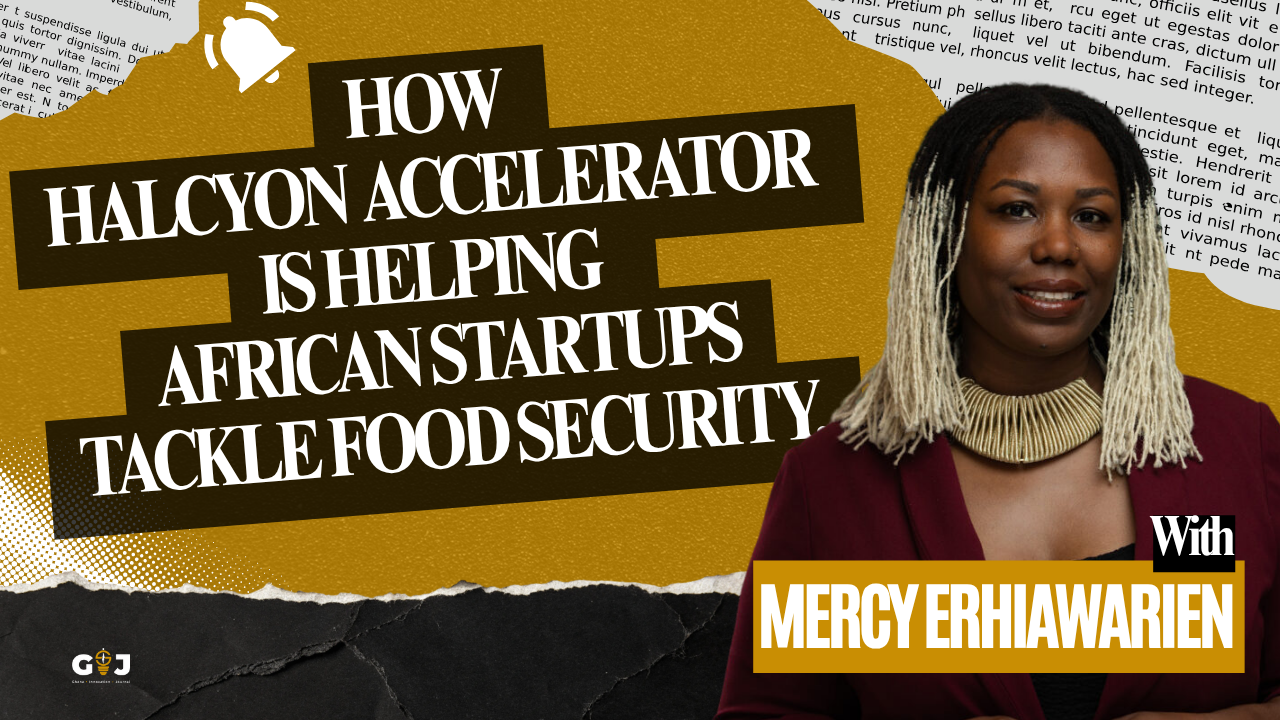
Climate change is no longer a future threat for sub-Saharan Africa, it is an active disruptor of food production. Farmers across the continent face more frequent droughts, volatile shifts in rainfall patterns, and rising temperatures that heavily strain local food systems. Ironically, while smallholder farmers produce over 90% of the continent’s food, they remain among its poorest citizens.
Few weeks ago in Accra, Ghana, a new wave of impact-driven startups gathered for the residency week of the Climate and Food Security Accelerator, run by global social impact incubator Halcyon.
The Ghana Innovation Journal sat down with Mercy Erhiawarien, Senior Manager of International Programs at Halcyon, to discuss how the accelerator is equipping founders to break the cycle of lack, the flaws of chasing “unicorns” in Africa, and why local capital must step up to fund climate adaptation.
Ghana Innovation Journal: Could you introduce us to Halcyon, what it stands for, and your specific role within the organization?
Mercy: Halcyon is a social impact accelerator that supports impact-driven founders across the world in three core areas: climate, health, and equity tech. As the Senior Manager of International Programs, I support founders across Africa, Latin America, the Caribbean, and Mexico.
GIJ: Climate change is acutely affecting African agriculture. What is Halcyon’s specific focus when addressing these pressures on our food system?
Mercy: Our Africa program focuses heavily on climate resilience and food security. When we talk about these challenges, we often overlook the people at the center of the ecosystem. Smallholder farmers produce over 90% of the continent’s food, yet they are among the poorest people. It fundamentally doesn’t make sense that you can work in agriculture, feed a nation, and still live in poverty.
What we and our founders are doing is supporting these smallholders by providing them with access to high-quality inputs, direct paths to markets, and opportunities to scale their businesses. The goal is to end this constant cycle of lack.
GIJ: Beyond immediate weather disruptions, what do you view as the most urgent structural challenges facing African agriculture today?
Mercy: There is a glaring contradiction we hear about constantly: people call Africa the potential “breadbasket of the world,” yet we import the vast majority of our food items. We grow the crops, but we don’t process them locally. There is a massive gap in the agricultural sector regarding the pace of industrialization.
Impact startups are perfectly positioned to solve this by figuring out how to scale processing and supply chains. Furthermore, climate resilience isn’t just about soil; it’s deeply tied to energy and water. The founders we brought to Accra this week are building direct solutions for clean energy and water management. Africa emits the lowest amount of greenhouse gases globally, yet we bear the heaviest consequences of climate change—from flooding to famine. At Halcyon, we believe in backing the proximate leaders who are closest to these problems.
The selection: lived experience and early traction
           HALCYON'S THREE CORE CURRICULUM PILLARS

   [ Capital Strategy ] ─── [ Leadership & Impact ] ─── [ Product-Market Fit ]
   Moving away from a       Measuring intentional and   Identifying target users
   purely "grant-reliant"   unintentional business      to transition from grant
   growth model.            consequences.               funding to real revenue.
GIJ: Accelerators are highly competitive. What do you look for when selecting founders, and what distinguishes a successful applicant from the rest?
Mercy: We believe traditional institutions are often slow or unwilling to solve global crises. Therefore, founders who possess lived experience with these issues are the best positioned to address them.
When vetting founders, we look for three distinct criteria:
- Impact and adaptation: They must be building a market-based solution with measurable climate adaptation at its core.
- Innovation: We look at how innovative they are in reaching new client bases or structuring their operations.
- Founder character: We evaluate the talent, grit, and character of the founders themselves to ensure they can carry the business through tough cycles.
Crucially, we look for early-stage startups—not just an idea on paper. We select founders who have already channeled their energy into execution, meaning they have a minimum viable product and are already generating initial sales.
Rethinking African Venture Capital
GIJ: Now that you’ve been on the ground with this cohort for a few days, what are the primary challenges the founders are voicing?
Mercy: Access to capital is always the biggest hurdle. These founders are building vital impact businesses, but traditional capital markets are risk-averse when it comes to the African continent. Because the time-to-return on investment for a hardware-heavy climate venture is longer than a pure software fintech app, many venture capitalists hesitate.
At Halcyon, we coach them on capital strategy. We help them answer: How do you practically build? Who are the right partners to scale with?
We also have to change the narrative around fundraising. I personally believe that Africa should not focus on breeding “unicorns”. We have a massive population; what we desperately need is a robust middle economic base. We don’t have enough African-owned, mid-sized sustainable businesses. If you only focus on unicorns, you create a massive economic gap between extreme wealth and poverty. We want founders who build foundations to stay in business for a long time, not raise capital quickly and fail quickly.
“I personally believe that Africa should not focus on breeding ‘unicorns.’ We need a robust middle economic base… We want founders who stay in business for a long time, not raise capital quickly and fail quickly.”
GIJ: Once these startups graduate from the accelerator, how does Halcyon ensure long-term growth and prevent them from operating in isolation?
Mercy: Once you enter Halcyon, you are part of the family forever. We have over 650 alumni globally. Our dedicated alumni team provides continuous resources and introductions to capital allocators and industry experts as their needs evolve. We track their progress through strict impact surveys at 6, 12, and 24 months.
One of the most exciting things is watching our alumni network cross-pollinate. We have peer networks on WhatsApp where an African founder traveling to the Middle East or a US founder looking to expand into Africa can instantly connect with local, trusted peers.
De-risking investments and shaping policy
GIJ: Local investors can sometimes operate in silos. How can local Ghanaian and West African investors better collaborate with Halcyon?
Mercy: Accelerators like Halcyon serve as essential matchmakers and risk-mitigators for investors. We spend weeks building deep, personal relationships with these founders; we understand their working styles, financial discipline, and character. By the time an investor looks at a Halcyon startup, we have effectively de-risked the opportunity.
We would love to partner more deeply with Ghanaian investors. We need local capital to show a greater appetite for investing across borders within the region. We want to connect with local angels and institutional funds to match them with ventures that precisely fit their investment mandates.
GIJ: Looking forward, how can media platforms like the Ghana Innovation Journal collaborate with Halcyon to tell these deeper stories?
Mercy: Media organizations sit in a powerful position to humanize the ecosystem and highlight the lived realities of building a business here. We want to grant you access to our African founders so you can report on their real operational struggles, triumphs, and market entry milestones.
Furthermore, regulatory bodies remain a massive bottleneck for founders. Through deep-dive journalism, we can co-collaborate to show how policies affect agtech and help startups advocate for a more supportive regulatory environment.
What’s next for Halcyon Accelerator
GIJ: What can we expect next from this current cohort, and what else is on Halcyon’s immediate horizon?
Mercy: This current Climate and Food Security cohort is kickstarting their residency here in Accra, but they will be concluding the journey in Nairobi, Kenya, this coming July. This will introduce the founders to a entirely different regional ecosystem, and we welcome the media to follow that journey to see how they adapt.
Globally, we have just launched our Global Climate program, and we are actively recruiting for our Caribbean Climate Pre-Accelerator. We also finalized our selections for the Climate Mexico program just yesterday.
Whether you are an impact founder in the Caribbean or a local investor in West Africa looking for vetted pipeline opportunities, we urge you to break down the silos and reach out to us at Halcyon.
To learn more about Halcyon’s programs or to get in touch regarding investment partnerships, visit their official website .