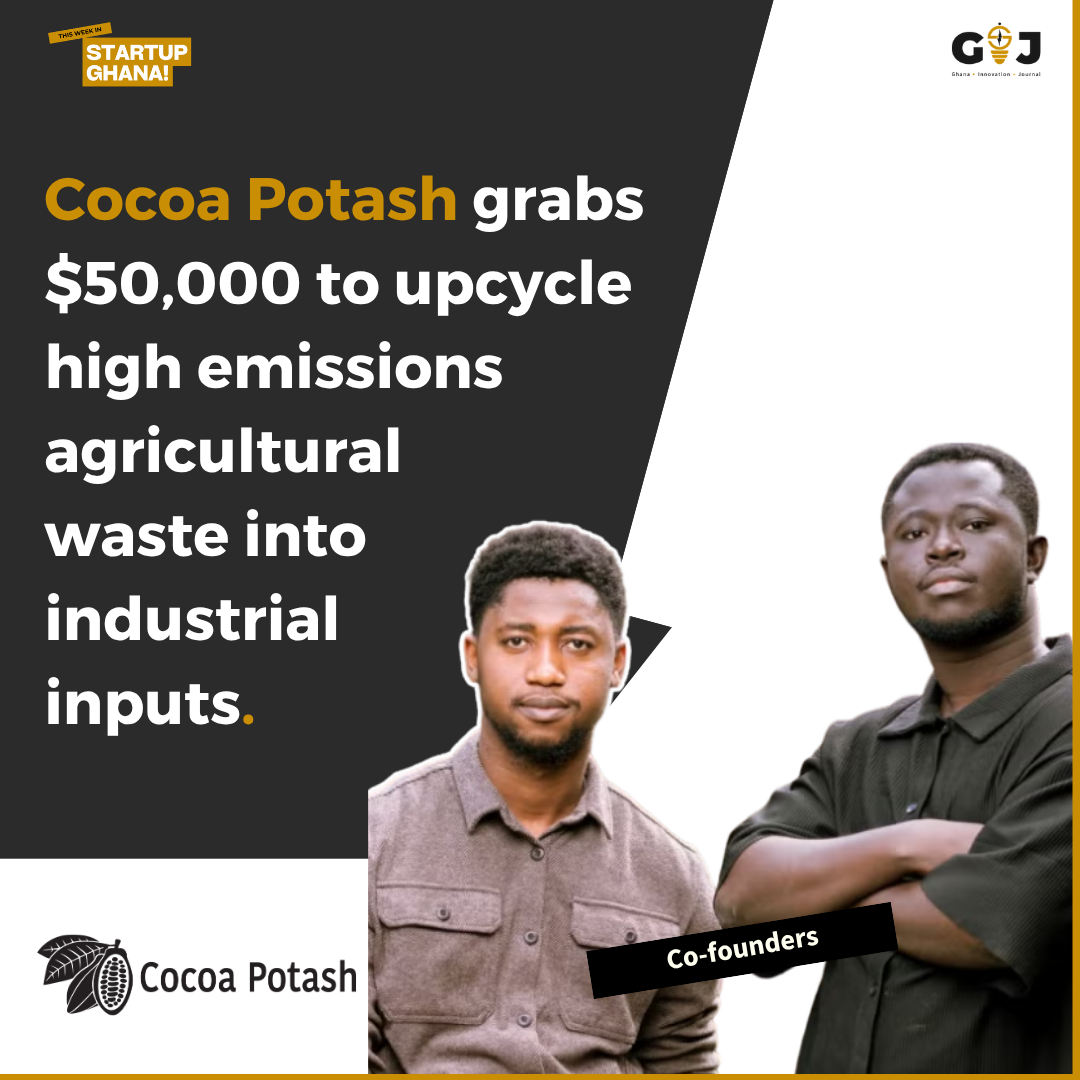
Agricultural waste is becoming a source of high purity industrial chemicals. That is the core idea behind Cocoa Potash, the Ghana US-based startup that recently secured $50,000 in funding after winning Penn State University’s Land Grant Startup Launch Competition.
The competition organised by Penn State’s Smeal College of Business and the College of Agricultural Sciences supports student-led early-stage food and agriculture ventures focused on sustainability.
Cocoa Potash emerged winner from a field of 20 applicants and three finalists, earning the Garber Venture Capital prize.
The Problem: Traceability and Carbon in Chemicals
Potash is a critical input for everything from fertilizers and glass to batteries and electronics. However, traditional sourcing is often high carbon and lacks the traceability required by modern ESG standards.
Cocoa Potash bridges this gap by upcycling high emission agricultural waste. By processing husks from cocoa, coconut, and palm nuts, the team produces organic, low carbon potash. For global manufacturers in pharmaceuticals, cosmetics, and food processing, this provides a traceable alternative to conventional chemical inputs.
The Team

The team is composed of engineers who come from cocoa farming backgrounds. Having experienced firsthand the challenges of seasonal income and agricultural waste, they set out to create additional income streams for farmers while addressing the problem of agricultural waste.
The company is led by CEO Ibrahim Quagraine and CTO Thomas Tawiah Baah, who hold PhDs in Bioengineering and Materials Engineering respectively.
They are complemented by COO Prince Agyei Baffour, a chemical engineer focused on operations and supply chain execution, and CFO Ithabeleng Makhetha, a former Big Four analyst.
Together, the team combines technical depth with operational and financial execution, enabling both process development and scalable production.
Traction
Cocoa Potash has transitioned from a lab-based concept to a revenue-generating business. During its Hult Prize pitch last year, the startup reported $84,000 in sales. It also outlined strong unit economics, with organic potash produced at a cost of $1.43 per kilogram and sold at $2.00 per kilogram, resulting in margins of approximately 30 to 35 percent.